|
Relatively small in size, Serbia is
huge in history and tradition. A country of so many nationalities, accents, customs and ways of
life deserves to be explored in depth: from sophisticated places of
the capital to Sumadija's unrestrained rural charm; from the flat land of the
north to the exciting scenery of the south; from sturdy fortifications
of the Middle Ages to postmodernist architecture of today; from the flavor of
the East to the taste of the West. Serbia is a wonder-full
place!
Our tours into this country's past do not emphasize a scholarly analysis of
history's problems and contested facts. They simply aim to present and interpret the most important
monuments and the frequently overlooked remains of cultures which once flourished here or which
briefly touched the region.
Even for the most experienced traveler, Serbia still holds secrets to
be discovered. Great sights, exotic scenes, pastoral landscapes and friendly people await everywhere
all the time. Each tour brings new adventure and a new, strange
mingling of impressions and sensations - in fact anything but ordinary. These are
really discovery tours, brimming with coleur locale and genuine excitement
for this country!
|
Tour # 9
|
|
Manasija &
Ravanica
|
|
'Monastery tour' by private car/minivan
Duration: 8-9 hrs, total
mileage 380
km/mile 236
|
On this tour we
explore some fascinating medieval monuments, two important monasteries - the endowments of two brave Serbian rulers, a father and son, built in one of the
most difficult periods of Serbia's history, on the eve of long-lasting slavery
under the Ottoman Empire.
 |
Drive along the Belgrade-Nis highway. A short stop at the Stari Hrast Motel.
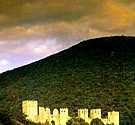
Upon arrival at the Manasija monastery (founded by Despot Stefan Lazarevic
in the first half of the 15th century), you will visit the best preserved medieval fortification
in Serbia (with 12 towers). You will view the ruins of
the old refectory and the Church of the Holy Trinity with its exceptionally fine
fresco paintings. An optional lunch may be arranged at one of the restaurants
in the Despotovac area or at the Stari Hrast Motel. In the afternoon you
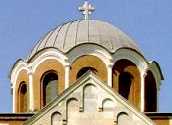
will visit the Ravanica monastery, founded by the Serbian Prince Lazar in
the second half of the 14th century. Here you will see the most typical example
of what is called the Morava school of Serbian medieval architecture. The
monastery's five-domed Church of the Ascension reveals rather badly damaged but
very fine frescoes. On display in the church is a transparent coffin containing relics of the great and
highly devoted ruler Prince Lazar, killed in the battle of Kosovo in 1389 and
soon afterwards declared saint (the
relics can be seen only on Sundays). Return to
Belgrade.
What
our clients say about
this tour and its guide
 "The most wonderful
tour I have ever been on." "The most wonderful
tour I have ever been on."
"Made complicated history easy to
understand and fun at the same time."
|
|
Fruitful
artistic creations
The last phase in the art of independent mediaeval Serbia is testified to
by the many monasteries and churches, whose architecture and painting bear
the stamp of the 'Morava school'. The light and slender forms of this
architecture are highly decorated.
|
|
Tour
# 10
|
|
Castles on the
Danube
|
|
'Medieval
tour'
by
private car/minivan
Duration: 8-9 hrs, total mileage 300 km/mile 188
|
On this tour we
explore some sturdy fortifications and superb castles down the Danube,
situated on the banks of the Balkan's most strategically important waterway:
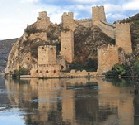
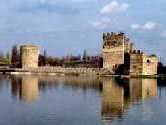
At Smederevo you will visit the last fortified capital of the medieval independent Serbian state and
at Golubac you'll view a medieval castle perched on a rock above the river.
 |
Drive
via the favorite Belgrade's excursion spot of Grocka to the west of Belgrade
(short stop) and to the former Serbian capital Smederevo, now a vast
castle on the Danube surrounded by a modern town. You will tour the
triangular shaped medieval fortification with its 25 huge towers, moat and
citadel. Next, we pass Pozarevac, the regional center of the Branicevo district and a picturesque
19th century town with a rich ancient Roman and
medieval tradition, especially known for its stud farm in Ljubicevo, founded
in 1858. We will make a brief visit to the picturesque, 14 km long and 300 meters wide, Silver
Lake (coffee break or optional lunch). Then we will drive along the old, slightly meandering road to the castle of Golubac
to visit these superb medieval ruins situated at the entrance to the Djerdap Gorge. The mighty
citadel was built in the second half of the 13th century on
inaccessible rocks above the Danube, at the point where the riverbed begins
to narrow, allowing the citadel to monitor all traffic across the
Danube. With its nine towers, each between 20 and 25 meters high,
and all connected by a curtain wall with an average width of
2.8 m, the castle was once used as an important stronghold on the right bank of the Danube. Return to Belgrade. |
|
Mediaeval
fortifications
There are many surviving fortifications from the Middle Ages, during the
period of the highly-developed and powerful feudal state. The enormous,
usually stone ruins of these can be found all over the country.
|
|
Tour # 11
|
|
Treasure
of Vojvodina
|
|
'Baroque
tour'
by
private car/minivan
Duration: 7-8 hrs, total mileage 220 km/mile 137
|
On this tour we
explore mild landscape of the fertile Pannonian Plain covered with grain fields, quaint
small towns and some splendid Baroque monuments - the area north of the Sava and
Danube, once ruled by ambivalent Hungarian kings and the ambitious Habsburg dynasty.
 |
Drive via the old town
of Zemun (visit) to the north, where a warm welcome from the province of Vojvodina
and its major tourism sights await you. Upon arrival in the region of Fruska
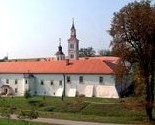
Gora, we will visit Krusedol
monastery (founded in the 16th century) known for its attractive location,
historical importance and a variety of paintings and icons in its church. Next,
a stop in the romantic town of Sremski Karlovci,
once a hub of the cultural and
political life of the Serbs. You will enjoy a panoramic guided walk
of the town center, which features the Baroque 'Four Lions' fountain on the main square (1790),
a 19th century High school, the Patriarch Palace and the
mid-18th century Cathedral
church with its fine Renaissance facade and two Baroque belfries. En route to Novi
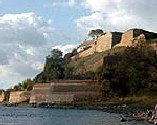
Sad we visit the famous fortress of Petrovaradin, built in the 17 and
18th centuries, and once called "Gibraltar on the Danube". This Austrian artillery fortification is situated above the
river and
represents the second largest structure of its kind preserved in Europe.
Later, you will take a brief panoramic tour of Novi Sad, the
capital of Vojvodina, followed by a short walk along picturesque Dunavska
Street. An optional lunch and free time for shopping complete the tour. Return to
Belgrade.
What
our clients say about
this tour and its guide
"Wonderful and painstaking guiding."
"Combined
facts with humorous details." |
|
Old
culture with new ideas
The end of the 17th century, the period of the great Serbian migration
under Patriarch Arsenije III, marks the start of a new era in the whole
life of the Serbs on the territory of Vojvodina and particularly in the
history of their art.
|
|
Tour # 12
|
|
Topola &
Oplenac
|
|
'Dynasty
tour'
by
private car/minivan
Duration: 7-8 hrs, total mileage 200 km/mile 124
|
On
this tour we explore typical 'rebellious Serbia' in the south of Belgrade,
homeland of Djordje Petrovic, called Karageorge or "Black George" for his dark
features. He led the uprising against the Ottoman rule in 1804 and established one
of the two Serbian ruling dynasties in the 19-20th centuries.
 |
Drive to Mt. Avala
for a brief visit to the Mausoleum of the Unknown Hero,
situated on the mountain top (511 m), and offering a spectacular view of the landscape around the capital. Then we go to
the central parts of the hilly Sumadija
region, known as the cradle of Serbian uprisings against the Ottoman rule in
the 19th century. Upon arrival to Topola, we will visit the Church of
Our Lady,
erected by Karageorge (1811-1813), the Residence of Karageorge (now a museum dedicated
to the leader of the First Serbian Uprising), two
sturdy stone towers preserved from what was once a mighty fortification,
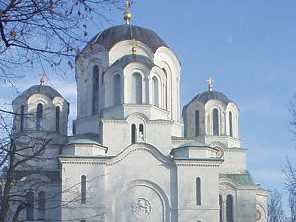
and more. Then, a short drive to the Church of St. George, built
after WWI by King Petar I of Serbia, on top of Oplenac (337 m). This
church is unique among all the monuments in Serbia, with columns made of Carrara
marble, an iconostasis of local marble and mosaics covering almost 3,500
sq. meters and including 725 scenes and 1,500 human figures. After sightseeing,
an optional lunch can be arranged in
the nearby town of Arandjelovac. We will also visit Bukovicka Spa and its
attractive park ornamented with many modern white marble sculptures
('Marble and Sound' Festival from 1968). On our way back to Belgrade a brief
stop at the village of Orasac where the historic meeting of Serbian
rebels took place in 1804.
What
our clients say about
this tour and its guide
"A fair introduction to life in contemporary Serbia."
"The
expertise of an experienced guide."
|
|
Revolutionary Serbia
The agreement to start the First Uprising against the Ottoman Turks was
announced at a spot near the village of Orasac on February 15, 1804. At
that historic and secret gathering of several outstanding Serbian
personalities, Karageorge was elected leader of the insurgents.
|
Please note:
All full-day tours include transportation
by private car or minivan, professional driver, guide
service, entrance fees.
Lunch is optional.
There is always at
least an hour allowed for lunch at a restaurant of your choice. If you prefer to
skip lunch and have a snack instead you could use that time to explore a little
on your own.
Tours usually commence from and terminate at your
hotel, unless we are requested otherwise.
|
Private
Excursions Prices
|
|
Starting from:
EUR 230 for a tour by car
(Per tour/car and not per person)

|
City Tours & Excursions in Greek
Περιηγήσεις
Περίπατοι
Μονοήμερες
Εκδρομές
Ξεναγήσεις
στα
Ελληνικά για
΄Ελληνες
επισκέπτες. Δείτε το
Βελιγράδι και
τη Σερβία με το
βλέμα του
τοπικού
ξεναγού!
Για
περισσότερες
πληροφορίες
και κρατήσεις,
παρακαλώ
επικοινωνείστε
απευθείας στο τηλέφωνο
η email.
|
|