|
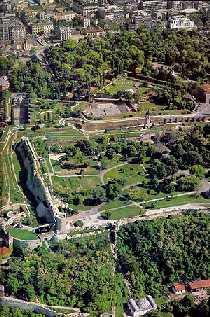 BELGRADE FORTRESS
is the most remarkable monument
of history preserved in the city. This is where the remains of Belgrade's distant past can best be seen: the site where Belgrade was founded
as a small fortified settlement in the 2nd century AD, and on
which it developed right down to the second half of the 18th century.
Along with artillery structures of the mid-18th
century, there are medieval ramparts, towers, gates and barbicans (15th
century), as well as some Byzantine and Roman remains. This historical site is
surrounded by a municipal park, bearing the old Turkish name of this place - Kalemegdan. BELGRADE FORTRESS
is the most remarkable monument
of history preserved in the city. This is where the remains of Belgrade's distant past can best be seen: the site where Belgrade was founded
as a small fortified settlement in the 2nd century AD, and on
which it developed right down to the second half of the 18th century.
Along with artillery structures of the mid-18th
century, there are medieval ramparts, towers, gates and barbicans (15th
century), as well as some Byzantine and Roman remains. This historical site is
surrounded by a municipal park, bearing the old Turkish name of this place - Kalemegdan. |
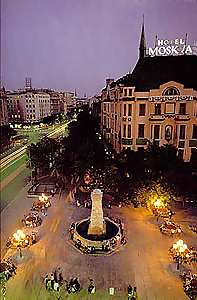
TERAZIJE
STREET with the Moskva Hotel (1906) and the
Old drinking fountain (1868). Conveniently located between two main
Belgrade's squares, this spot represents the heart of Belgrade. The name of the street is of Turkish origin
('Water scales'), referring to the old water supply
system during the period of Ottoman rule. Two high 'towers' -
water collectors were located here, resembling a scale and this
is how
the place got its name.
The Moskva Hotel, the major hallmark of this area, is the only hotel outside Russia that bears this name. |
|
|
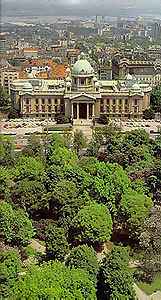 THE
HOUSE OF PARLIAMENT is one of the most attractive palatial buildings in
Belgrade. It was constructed in the period 1906-36 after the projects of
the architect Jovan Ilkic. Construction works were completed under
the supervision of his son, Pavle Ilkic. The palace is an example of
various architectural styles: Neo-Renaissance, Baroque, Classicism.
Great attention was also dedicated to the internal decorations. The
front entrance is embellished by two monumental sculpture
groups of the black horses, authored by Toma Rosandic. THE
HOUSE OF PARLIAMENT is one of the most attractive palatial buildings in
Belgrade. It was constructed in the period 1906-36 after the projects of
the architect Jovan Ilkic. Construction works were completed under
the supervision of his son, Pavle Ilkic. The palace is an example of
various architectural styles: Neo-Renaissance, Baroque, Classicism.
Great attention was also dedicated to the internal decorations. The
front entrance is embellished by two monumental sculpture
groups of the black horses, authored by Toma Rosandic.
|
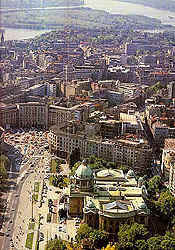 PANORAMA
OF THE CITY CENTER with the Federal Parliament building, Nikola Pasic Square and the Trade
Union Hall (dominating the scene). PANORAMA
OF THE CITY CENTER with the Federal Parliament building, Nikola Pasic Square and the Trade
Union Hall (dominating the scene).
In back: the Danube river with a tiny island covered by lush greenery (a
unique bird sanctuary and nature reserve).
In front: House of Parliament |
|
|
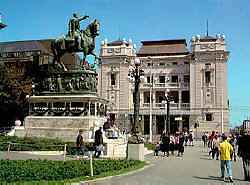 REPUBLIC
SQUARE with the National Theatre (1868) and the Monument to Prince
Michael Obrenovic (1882). The equestrian statue is cast in bronze (Mueller
Foundry, Munich). Behind the monument is the National Museum (not presented
here), founded in 1844. REPUBLIC
SQUARE with the National Theatre (1868) and the Monument to Prince
Michael Obrenovic (1882). The equestrian statue is cast in bronze (Mueller
Foundry, Munich). Behind the monument is the National Museum (not presented
here), founded in 1844. |
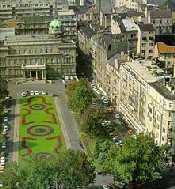 BELGRADE CITY HALL
(Assembly of the City of Belgrade) is situated in
the former Royal Court,
built in late 19th century for King Milan Obrenovic. This is one of
the most important architectonic achievements in town,
built on the
basis of the Italian Renaissance. The building was reconstructed on
several; occasions, but the original design by Aleksandar Bugarski has
been faithfully preserved. BELGRADE CITY HALL
(Assembly of the City of Belgrade) is situated in
the former Royal Court,
built in late 19th century for King Milan Obrenovic. This is one of
the most important architectonic achievements in town,
built on the
basis of the Italian Renaissance. The building was reconstructed on
several; occasions, but the original design by Aleksandar Bugarski has
been faithfully preserved. |
|
|
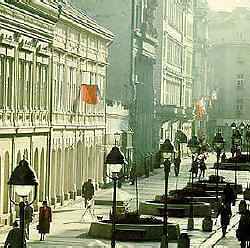 KNEZA MIHAILA
STREET
with a row of 19th century mansions. This was
the first street in Belgrade to be regulated and named. Nowadays, the street
is blocked off to all vehicular traffic and reserved for pedestrians only.
It is the main shopping mall and promenade connecting Republic Square with
Kalemegdan Park and the Fortress i.e. the archaeological
and historical zone of the city. KNEZA MIHAILA
STREET
with a row of 19th century mansions. This was
the first street in Belgrade to be regulated and named. Nowadays, the street
is blocked off to all vehicular traffic and reserved for pedestrians only.
It is the main shopping mall and promenade connecting Republic Square with
Kalemegdan Park and the Fortress i.e. the archaeological
and historical zone of the city. |
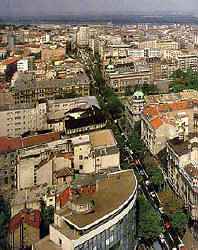 PANORAMA
OF KING MILAN
STREET
(formerly: Marshal Tito St) with the cupolas of the
'New'
Royal Court, built for King Alexandar I Karadjordjevic in 1913-16 (now:
Presidency of Serbia) and the 'Old' Royal Court, built for King Milan
Obrenovic in 1882 (now: City Hall). The main Belgrade street
connects Slavija Square with Terazije. PANORAMA
OF KING MILAN
STREET
(formerly: Marshal Tito St) with the cupolas of the
'New'
Royal Court, built for King Alexandar I Karadjordjevic in 1913-16 (now:
Presidency of Serbia) and the 'Old' Royal Court, built for King Milan
Obrenovic in 1882 (now: City Hall). The main Belgrade street
connects Slavija Square with Terazije. |
|
|
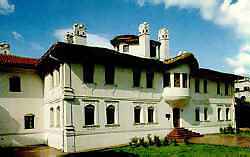 PRINCESS LJUBICA'S RESIDENCE
(1829-31), a court of Duke Milos Obrenovic, who
reestablished the modern Serbian state in the 19th century. The building is
an example of old, combined construction technique: Turkish 'daub and
wattle' system was supported here by refined brickwork. PRINCESS LJUBICA'S RESIDENCE
(1829-31), a court of Duke Milos Obrenovic, who
reestablished the modern Serbian state in the 19th century. The building is
an example of old, combined construction technique: Turkish 'daub and
wattle' system was supported here by refined brickwork. |
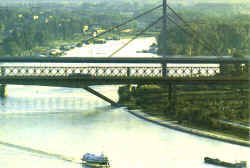 THE BRIDGES OF BELGRADE THE BRIDGES OF BELGRADE
Two parts of the modern city situated at the confluence of two
rivers are connected with 5 bridges on the Sava and 1 bridge on the
Danube. On the river's right bank lies the historical nucleus of Belgrade and
on the other side is New Belgrade. |
